Proudly serving Tucson, Oro Valley, Marana, Sahuarita, Green Valley, Vail & surrounding areasCall or Text 24/7: 520-569-2109

Spray Polyurethane Foam Roofing Installation & Maintenance in Tucson, AZ

Tucson Quality Roofing installs and repairs spray polyurethane foam roofing for flat and low-slope homes and commercial buildings in Tucson, Arizona. Our foam roofing services include new SPF installation, localized foam roof repair, reflective coating and recoating, inspections, and preventive maintenance. We also handle roof repair, roof replacement, tile and flat roof repair, shingle and metal roofing, emergency roof leak repair, and commercial roofing. Each foam project is planned around the roof's slope, drainage pattern, existing substrate, and rooftop equipment.

Tucson roofs can see summer surface temperatures climb past 150 degrees Fahrenheit, fast monsoon downpours between July and September, and relentless UV exposure. Those conditions attack seams, flashings, and aging membranes on conventional flat roofs. SPF creates a fully adhered, monolithic surface that removes the seams where many leaks begin. Before recommending it, we inspect the deck for moisture, delamination, and structural soundness so the proposed system fits the roof instead of covering an underlying problem.

Our crews follow Spray Polyurethane Foam Alliance application guidelines and finish the foam with an elastomeric topcoat applied at manufacturer-specified mil thickness to meet ASTM D6947 performance standards. Work is performed under Arizona Registrar of Contractors licensing and the permitting requirements of the City of Tucson and Pima County Development Services.

Tucson Quality Roofing provides foam roofing in Tucson, Oro Valley, Marana, Sahuarita, and the greater Pima County metro area.

★ ★ ★ ★ ★4.9/5 Average Rating · 20+ Years of Experience · Thousands of Customers Helped · Licensed & Insured · Residential & Commercial

Foam Roofing Options & Benefits

What Is SPF Roofing?

SPF roofing is spray polyurethane foam applied as a liquid that expands into a rigid, closed-cell layer. It combines insulation with a weather-resistant surface and conforms around flashings, vents, and other roof penetrations without creating laps or fastener holes.

That seamless construction is useful in Tucson, where roofs can cycle between 40-degree nights and 110-degree afternoons. At roughly 2,400 feet of elevation in a heat-trapping basin, local roofs also receive intense solar exposure that can shorten the life of an unprotected membrane.

A foam system must be matched to the building rather than treated as a universal overlay. Roof slope, drainage, ponding patterns, rooftop equipment, existing moisture, and deck condition all influence whether installation, repair, recoating, or another roofing approach is appropriate.

Benefits of Foam Roofing

A correctly installed foam roof creates one continuous assembly that insulates, sheds water, and supports a reflective protective coating. Its value comes from how those layers work together on flat and low-slope roofs exposed to Tucson heat and monsoon rain.

  • Monolithic coverage eliminates seams, laps, and fasteners where water often enters.
  • Closed-cell foam adds insulation beneath the reflective topcoat.
  • The coating reflects solar energy instead of absorbing rooftop heat.
  • The closed-cell structure resists moisture intrusion during periods of ponding.
  • Foam is lightweight, typically adding only a few pounds per square foot.
  • It can often be applied over an existing roof when the substrate is dry and sound.
  • Spray application seals around irregular HVAC, exhaust, plumbing, and flashing details.
  • Localized repairs and periodic recoating can renew protection without a full tear-off.
Spray Foam Roofing Services

Foam Roofing Services in Tucson

Our foam roofing work covers the full lifecycle of an SPF system, from evaluating the deck and installing new foam to repairing damage, renewing the coating, and planning preventive maintenance. Residential and commercial scopes are adjusted for roof access, drainage, equipment, traffic, and the condition of the existing assembly.

Foam Roof Installation

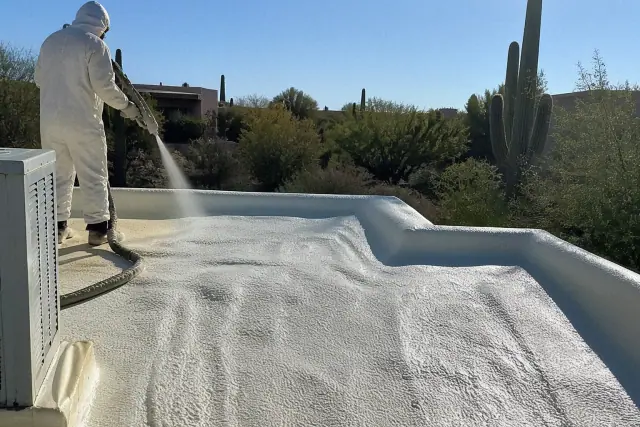
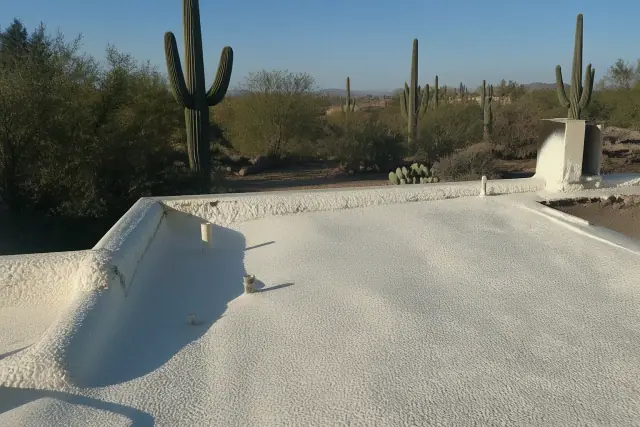
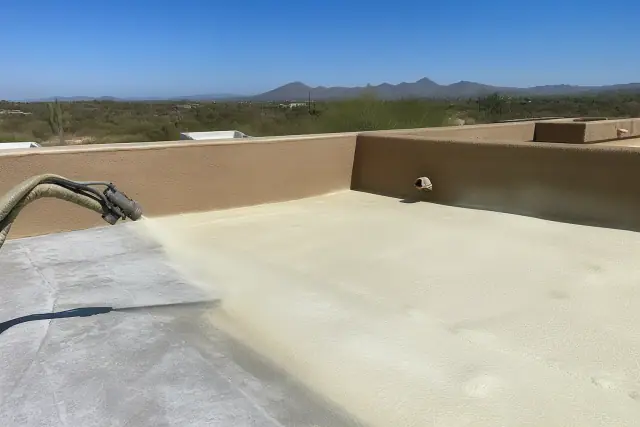
Operator spraying polyurethane foam insulation onto a residential roof in Tucson, AZ, with desert cacti in the background.

Installation begins with a sound, clean, primed, and dry substrate. Calibrated proportioning equipment mixes the A-side isocyanate and B-side polyol components at precise ratios, and crews apply the foam in controlled passes before adding the protective elastomeric coating.

Request Estimate

Foam Roof Repair

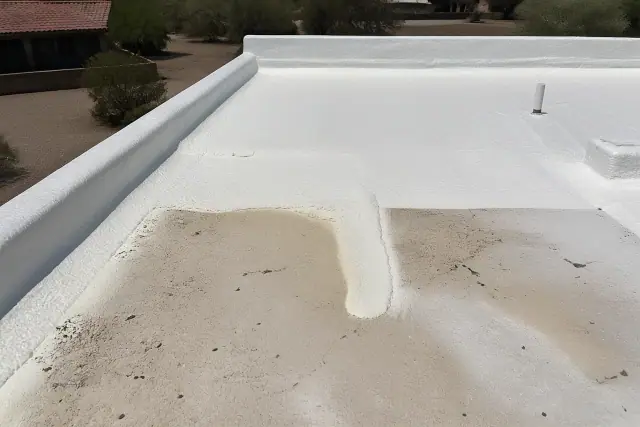
Polyurethane foam insulation being sprayed onto a residential flat roof during a repair in Tucson, AZ.

Repair starts by tracing coating wear, punctures, blistering, soft spots, or interior staining to the actual source. Matching the existing foam density and coating compatibility helps determine whether a localized patch, a broader recoat, or removal of wet material is required.

Request Estimate

Foam Roof Coating and Recoating

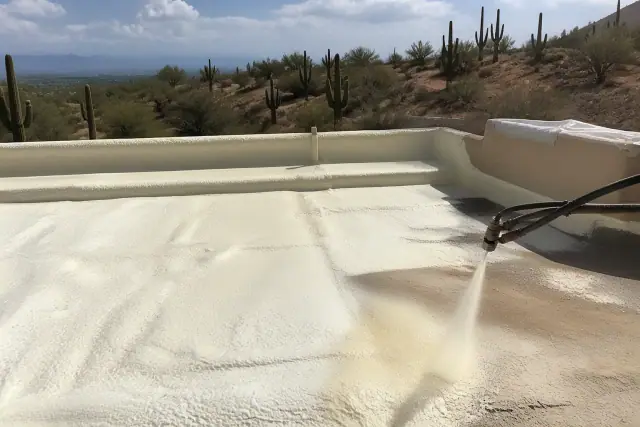
Spraying polyurethane foam insulation onto a roof at a construction site in Tucson, AZ.

Acrylic or silicone elastomeric coating shields the foam core from UV exposure and thermal shock. We probe the existing foam for moisture before recommending recoating, because a new topcoat over wet or unsound foam would trap the problem rather than correct it.

Request Estimate

Residential Foam Roofing

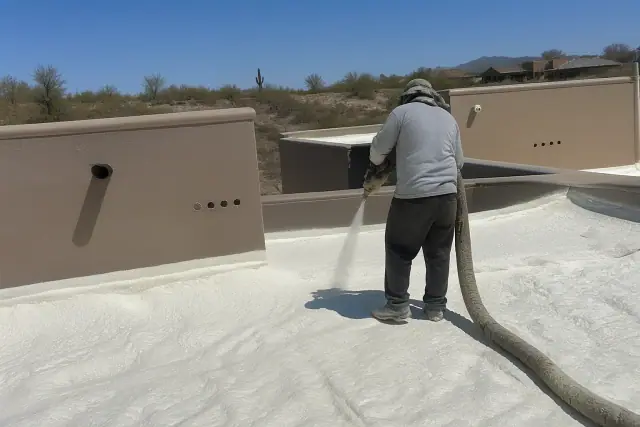
Contractor spraying polyurethane foam insulation on a residential rooftop in Tucson, AZ.

Residential SPF is suited to many flat and low-slope homes, including properties in Midvale Park and Dove Mountain where large roof areas can transfer substantial summer heat into the attic. The insulating foam and reflective surface help the roof resist leaks while reducing heat movement into the living space below.

Request Estimate

Commercial Foam Roofing

Worker spraying polyurethane foam insulation on a flat roof in Tucson, AZ with desert cacti in the background.

Warehouses, retail centers, and industrial buildings often have wide flat roofs crowded with HVAC, exhaust, and plumbing penetrations. Spray foam conforms around those details, and large sections can be completed in days rather than weeks with minimal disruption to operations below.

Request Estimate

Foam Roof Inspection and Maintenance

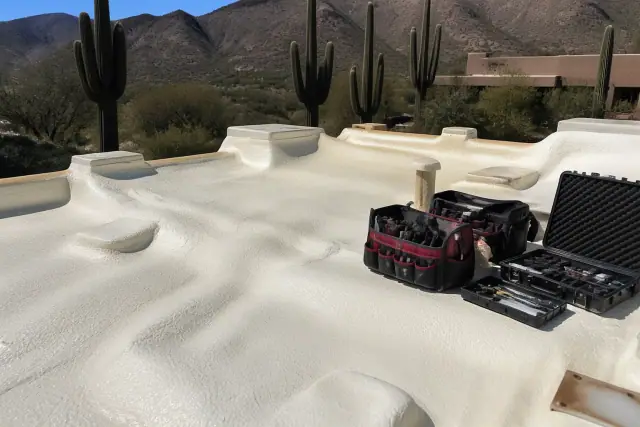
Technician tool kit on a finished foam roof with saguaro cacti in the background in Tucson, AZ.

We recommend a professional inspection at least once a year, ideally before monsoon season. The check covers coating thickness, blistering, ponding, drainage, and flashings, while cleaning palo verde debris, dust, and pooled sediment helps prevent avoidable coating wear.

Request Estimate
Systems and Applications

Foam Roofing Options

A complete foam roof pairs the SPF core with a compatible protective coating and any localized reinforcement the roof needs. The right combination depends on the existing assembly, drainage, UV exposure, foot traffic, and equipment access rather than a one-size specification.

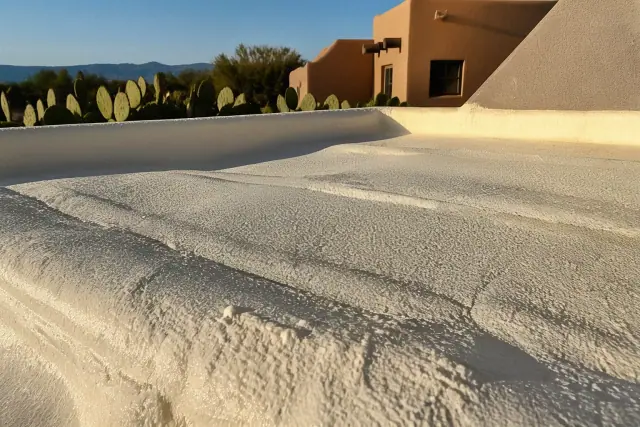
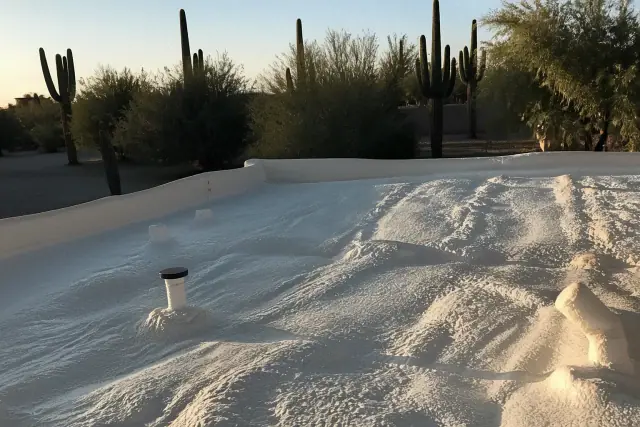
Cured closed-cell polyurethane foam roofing texture on a Tucson, AZ jobsite with cacti and stucco homes in the background.

Closed-Cell SPF Core

We install closed-cell spray polyurethane foam at densities of 2.5 to 3.0 lb/ft³. Applied correctly, it expands into a rigid, continuous layer that follows the roof's contours and supports both insulation and moisture resistance.

  • Rigid closed-cell structure
  • Continuous insulation across the roof
  • Seamless coverage around penetrations
  • Lightweight addition to the assembly
  • Weather-resistant base for the topcoat
Request Estimate
Acrylic elastomeric coating on a textured foam roof in the Sonoran Desert, Tucson, AZ.

Acrylic Elastomeric Coating

A quality acrylic elastomeric topcoat is one option for protecting the cured foam from Tucson's sun. It is applied at the specified thickness to reflect solar radiation, reduce thermal shock, and keep UV exposure away from the foam core.

  • Reflects solar radiation
  • Shields the SPF core from UV
  • Reduces daily thermal shock
  • Applied at manufacturer-specified thickness
  • Renewable through scheduled recoating
Request Estimate
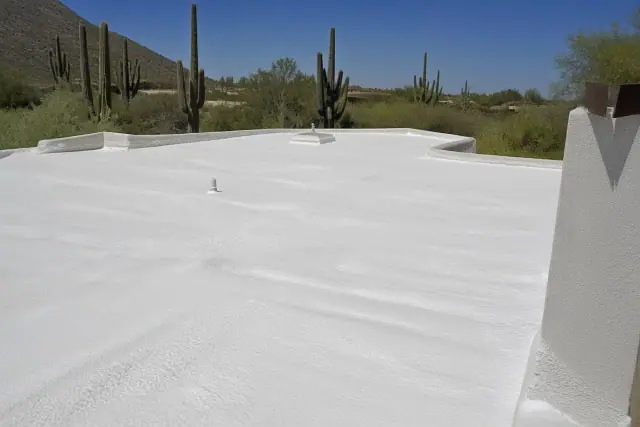
Freshly applied silicone elastomeric coating on a flat foam roof with desert landscaping in Tucson, AZ.

Silicone Elastomeric Coating

Silicone is another protective topcoat option for a foam roof. We select the coating system according to the roof's condition and exposure, then apply it over cured foam at the required thickness so the coating, rather than the foam, takes the weathering load.

  • Compatible protective finish selected for the roof
  • Applied only after the foam cures
  • Reflective protection from solar load
  • Specified thickness for complete coverage
  • Inspectible surface for future maintenance
Request Estimate
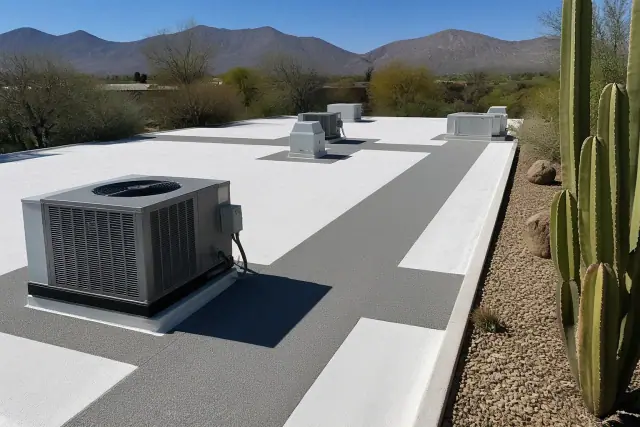
Granulated walkways and equipment pads on a roof in the Sonoran Desert, Tucson, AZ.

Granulated Walkways and Equipment Pads

Granules can be broadcast into the coating where added durability is needed around walkways or equipment pads. This focuses reinforcement on the roof areas most likely to see HVAC service traffic, dropped tools, and repeated access.

  • Added durability on service paths
  • Protection near rooftop HVAC units
  • Localized reinforcement where traffic occurs
  • Granules broadcast into the coating layer
  • Less avoidable wear from equipment access
Request Estimate
Polyurethane foam being sprayed over an existing roof during a project in Tucson, AZ.

Foam Retrofit Over an Existing Roof

SPF can frequently be installed directly over an existing roof assembly when the deck and substrate are dry, stable, and structurally sound. Inspection and moisture probing come first; wet insulation, delamination, or structural damage must be addressed before any overlay.

  • May avoid a complete tear-off
  • Requires a sound existing substrate
  • Moisture is checked before application
  • Wet insulation is removed and replaced
  • Lightweight foam limits added structural load
Request Estimate
Finding Your Right Fit

Choosing the Right Foam Roofing Approach

The right scope depends on what is happening below the visible coating. We evaluate the substrate, moisture, drainage, climate conditions, and permitting needs before deciding whether the roof is ready for new SPF, a localized repair, a full recoat, or more extensive deck work.

Thorough Substrate Assessment

We check for moisture intrusion, delamination, wet insulation, and structural soundness before spraying. Careful preparation prevents a new foam layer from hiding damage or bonding to a surface that cannot support it.

Climate-Controlled Application

Ambient temperature and humidity are monitored throughout application. Calibrated equipment and controlled passes keep the component ratio and foam expansion within the recommended window for strong adhesion and cell structure.

Licensed Local Compliance

Our licensed and insured crews follow SPFA application guidance while working within Arizona Registrar of Contractors licensing and local permitting requirements. That connects product technique with the City of Tucson and Pima County requirements that apply to the project.

What Sets Us Apart

Why Choose Us for Foam Roofing Installation?

Tucson Quality Roofing focuses on the details that determine whether an SPF roof performs: dry substrate preparation, correct foam-to-coating ratios, monitored spray conditions, compatible repair materials, and an honest assessment of the existing deck. Estimates explain whether the scope calls for installation, repair, recoating, or preliminary deck work.

Request Roof Assessment

UV Coating Wear

Tucson averages well over 300 sunny days a year, so the exposed topcoat takes constant UV stress. Chalking, fading, thinning, or cracking can leave the foam core vulnerable if the coating is not renewed in time.

Trapped Moisture and Blistering

Blisters and soft or spongy areas can indicate moisture trapped beneath the coating. Recoating over wet foam seals that moisture in, so affected material must be identified and addressed before the protective surface is renewed.

Ponding After Monsoon Storms

Heavy July storms can expose low areas and blocked drainage paths quickly. Persistent ponding stresses the coating, so the inspection considers the roof's slope, sediment, drains, and water patterns instead of treating the visible puddle alone.

Foot-Traffic Damage

Repeated service access near HVAC units can wear or puncture the coating, especially when walk pads are missing. Localized reinforcement and compatible repairs protect these traffic zones without disguising damaged foam underneath.

Hail and Puncture Damage

Monsoon hail is less common here than in some regions, but it can puncture an older topcoat. Dropped tools can cause similar damage, creating small openings that should be repaired before rain reaches deeper into the foam core.

Poor Adhesion and Cell Structure

Incorrect component ratios, unsuitable weather conditions, or inadequate surface preparation can cause poor expansion, weak cells, and adhesion failure. DIY patches that do not match the foam density and coating compatibility can create another weak point that fails within a season.

How It Works

Our Foam Roofing Process

A durable SPF system depends on disciplined work before, during, and after spraying. Our process moves from inspection and moisture correction through surface preparation, calibrated foam application, and a complete protective coating.

01.

Inspect the Roof Deck

We inspect the roof deck, existing membrane, flashings, penetrations, drainage, and rooftop equipment. Moisture intrusion, delamination, ponding, and structural soundness are documented before a scope is recommended.

02.

Remove Wet or Unsound Materials

Wet insulation is removed and replaced, and damaged or structurally unsound areas are corrected before foam is introduced. This prevents moisture from being trapped beneath a new assembly.

03.

Clean, Prime, and Dry the Surface

The substrate is cleaned, primed, and dried to the moisture content required by the SPF manufacturer. Careful preparation is essential because contamination or residual moisture can undermine adhesion.

04.

Calibrate the Spray Components

Proportioning equipment is calibrated to mix the A-side isocyanate and B-side polyol at precise ratios. Crews also monitor ambient temperature and humidity so application stays within the recommended window.

05.

Apply SPF in Controlled Passes

The mixed SPF is sprayed in controlled passes to build a continuous closed-cell layer over the prepared roof. Application follows slopes and seals around vents, flashings, curbs, and other irregular details.

06.

Coat, Reinforce, and Verify

After the foam cures, the elastomeric topcoat is applied at the specified thickness. Granules are added where walkways or equipment pads need more durability, and the finished surface, drainage, and detail coverage are checked.

Plan the Right Scope

Schedule a Foam Roofing
Consultation

Tell us whether you are considering a new foam roof, seeing damage on an existing system, or planning a recoat before monsoon season. We will evaluate the roof and itemize the recommended work so substrate repair, foam application, coating, access, and disposal needs are clear in the estimate.

Foam Roof Help

Foam Roofing FAQs

These answers cover lifespan, recoating, cost, installation, repairs, and roof suitability for Tucson properties. A roof-specific assessment is still important because moisture, drainage, substrate condition, access, and equipment layout can change the appropriate scope.

Call Our Roofing Team

With proper maintenance, a foam roof in the Tucson area typically lasts 20 to 30 years. Industry data also shows that correctly applied spray foam can extend an aging roof's service life by up to 20 years compared with leaving the old membrane unaddressed. Coating condition and timely repairs determine whether the system reaches the longer end of that range.

We generally recommend recoating every 5 to 10 years because Tucson roofs face strong UV exposure and monsoon stress. Roofs with heavy sun, ponding, or frequent rooftop traffic may need attention closer to the 5-year mark, while well-drained roofs with light traffic may approach 10 years. Annual inspection is the best way to judge the actual coating condition.

Material and labor typically run $5.00 to $8.00 per square foot, or roughly $400 to $700 per roofing square. Full installations commonly cost around $7,000 to $8,500 for 1,000 square feet, $9,000 to $11,000 for 1,500 square feet, and $11,000 to $14,000 for 2,000 square feet. Applying foam over a sound existing roof generally costs $3,500 to $13,000 or more, while tear-off or structural repair adds labor and disposal costs.

SPF requires a skilled installer because poor surface preparation, incorrect mixing ratios, or spraying outside the recommended weather window can weaken adhesion and cell structure. The coating also needs periodic renewal, and foot traffic or dropped tools can puncture unprotected areas. Foam is best suited to flat and low-slope roofs rather than every steep-slope roof.

The formal trade name is SPF roofing, short for Spray Polyurethane Foam roofing. It is a lightweight, non-toxic, weather-resistant system sprayed as a liquid that expands into rigid closed-cell foam and is then sealed with a protective elastomeric coating. It may also be described as spray foam roofing.

SPF roofing is typically part of an unvented, or hot-roof, assembly because closed-cell foam acts as an air and moisture barrier at the roof deck. Ventilation needs elsewhere in the building still depend on the construction and HVAC design. We evaluate the existing assembly rather than assuming one venting approach fits every property.

Watch for chalking or fading coating, soft or spongy areas, blisters, punctures, ponding, and interior ceiling staining after a storm. Early damage may be suitable for a localized repair or recoat. Moisture that has spread into the foam core can require a broader repair scope.

Foam can frequently be applied over an existing roof assembly when the substrate is dry, stable, and structurally sound. The deck and insulation must be checked first, and wet material needs to be removed and replaced. An overlay is not a shortcut for covering trapped moisture or structural damage.

The elastomeric topcoat is the layer that absorbs UV and weather exposure so the foam core does not. Its reflective surface also reduces heat absorption and thermal shock. Acrylic or silicone coating must be applied at the specified thickness and renewed before wear exposes the foam.

A professional inspection checks coating thickness, blistering, ponding, drainage, and flashing around roof penetrations. Cleaning removes dust, palo verde debris, and pooled sediment that can block drainage or concentrate wear. Scheduling the inspection before monsoon season gives time to repair thin spots or punctures.

SPF is a practical option for many flat and low-slope residential, commercial, warehouse, retail, and industrial roofs. It conforms around complex penetrations and can work over a sound existing assembly. Steep-slope roofs may be better matched to shingle or tile, so deck condition and roof geometry should be evaluated first.

The closed-cell foam adds insulation while the reflective coating sends solar energy away from the roof instead of absorbing it. That combination reduces heat transfer into attics and occupied spaces, so rooftop and indoor cooling equipment does not have to respond to as much roof-generated heat. Actual savings depend on the building and existing roof assembly.

Recoating is appropriate when the foam beneath the worn coating remains dry and structurally sound. Punctures, wet foam, failed adhesion, or damaged insulation must be repaired before a new topcoat is applied. Moisture probing and deck inspection distinguish surface wear from a deeper problem.