Proudly serving Tucson, Oro Valley, Marana, Sahuarita, Green Valley, Vail & surrounding areasCall or Text 24/7: 520-569-2109

Tile Roof Repair, Restoration & Underlayment Services in Tucson, AZ

Tucson Quality Roofing repairs broken, cracked, loose, and missing tile for homes and commercial buildings across Tucson. Our tile roof repair services cover clay tile, concrete tile, discontinued profiles, leaks, underlayment failures, lift-and-relay work, and full restoration. We match replacement pieces through regional salvage yards and tile inventories when older profiles are no longer manufactured. The goal is to correct the failed component while leaving sound parts of the roof intact.

Tucson's 100-plus days a year above 100 degrees, intense UV, and July and August monsoon storms expose tile assemblies to heat, hail, wind, and sudden rain. Dust storms and haboobs can also shift tile without leaving an obvious break visible from the ground. We inspect the whole roof plane with foam pads, document cracked, slipped, or missing tile, and trace leaks to underlayment, flashing, or fasteners before quoting repairs. As a licensed, bonded, and insured Arizona roofing contractor, we follow manufacturer specifications along with current International Building Code and City of Tucson permit requirements where applicable.

Tile surface temperatures can push a summer roof deck above 150 degrees, so high-heat underlayment and correct fastening matter. After an on-site inspection, we provide a written quote based on tile material, roof pitch, affected planes, matching needs, and access.

Tucson Quality Roofing provides tile roof repair throughout Tucson, Oro Valley, Marana, Sahuarita, Vail, and surrounding Pima County communities.

★ ★ ★ ★ ★4.9/5 Average Rating · 20+ Years of Experience · Thousands of Customers Helped · Licensed & Insured · Residential & Commercial

Tile Roof Repair Options & Benefits

What Is Tile Roof Repair?

Tile roof repair addresses the broken surface tile and the hidden assembly beneath it. Clay and concrete tile can remain serviceable for decades, while underlayment, fasteners, battens, flashing, and mortar may fail much sooner.

A proper repair begins by finding the real entry point or damaged component, not assuming the ceiling stain sits directly below the leak. Water can travel along felt or synthetic underlayment before it reaches the decking and interior.

Depending on the findings, the work may involve replacing a few tiles, repairing flashing, patching underlayment, or lifting and relaying an entire tile field. This targeted approach preserves sound tile and avoids a full tear-off when the rest of the roof remains serviceable.

Benefits of Timely Tile Roof Repair

Prompt repair limits the path water can take beneath a tile field and helps keep a small failure from spreading into underlayment, decking, insulation, and drywall. It also allows sound clay or concrete tile to remain in place instead of being discarded unnecessarily.

  • Corrects the failed component instead of masking the visible symptom
  • Helps prevent water from reaching decking, insulation, and drywall
  • Preserves serviceable clay and concrete tile whenever possible
  • Restores slipped tile and failed fasteners to proper alignment
  • Uses high-heat underlayment suited to Tucson tile assemblies
  • Addresses flashing at valleys, penetrations, hips, and ridges
  • Supports close visual matching for discontinued tile profiles
  • Applies to residential homes and commercial tile roofs
Tile Roof Services

Complete Tile Roof Repair Services

Our repair scope can range from replacing individual broken pieces to opening a roof plane and renewing the underlayment beneath it. Each recommendation reflects the tile material, source of failure, roof access, and amount of the field affected.

Broken Tile Replacement

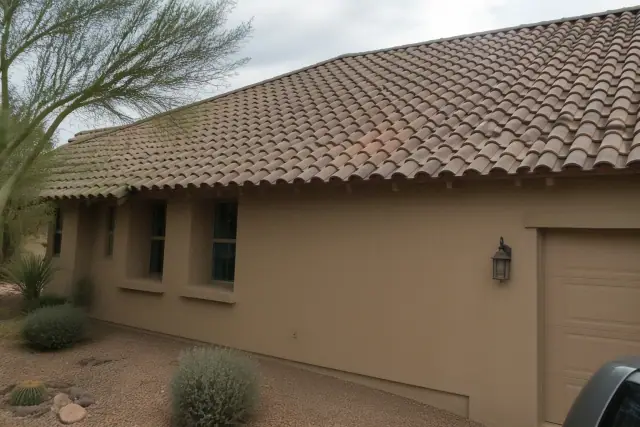
Newly installed clay roof tile interlocked with weathered tiles on a tan stucco home in Tucson, AZ.

We replace hairline-cracked, shattered, spalling, slipped, and missing tile caused by hail, falling palm fronds, foot traffic, freeze-thaw cycling, or failed fastening. Existing profiles are matched from current stock, tile inventories, or regional salvage suppliers when a style has been discontinued.

Request Estimate

Clay Tile Roof Repair

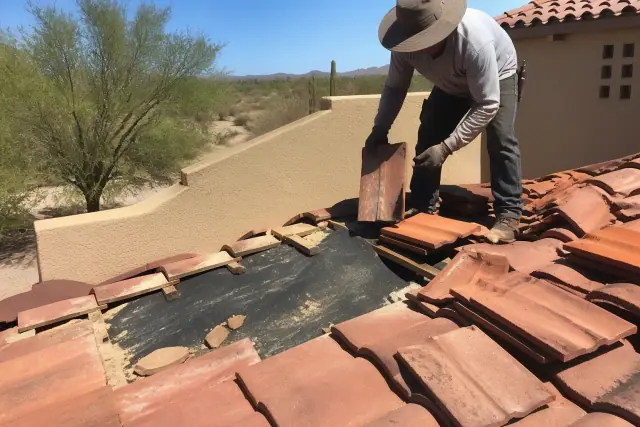
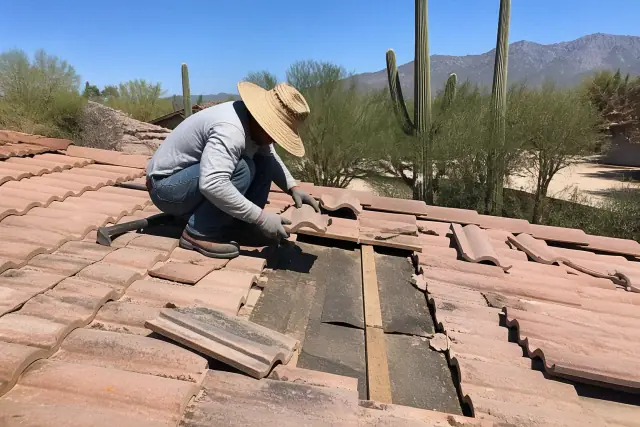
Roofer removing clay tiles to inspect the underlayment during a roof repair project in Tucson, AZ.

Clay tile resists UV exposure and holds its fired color, but its brittleness makes it vulnerable to shattering from hail and careless foot traffic. We match clay profiles, re-secure loose pieces with code-compliant fastening, and replace failed flashing rather than caulking over the symptom.

Request Estimate

Concrete Tile Roof Repair

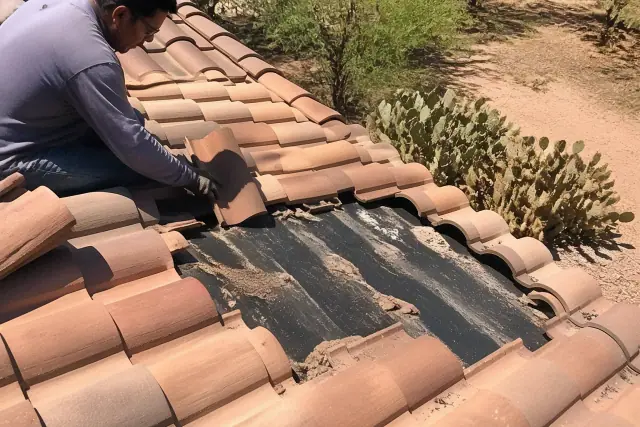
A roofer repairing clay tiles on a roof with visible underlayment and prickly pear cactus in the background, Tucson, AZ.

Concrete tile is heavier and more impact-resistant than clay, but its factory color coat can fade and chalk under Arizona sun. Repairs can include replacing damaged pieces, correcting fastener or adhesive failure, matching color, and evaluating the underlayment below the field.

Request Estimate

Tile Roof Leak Repair

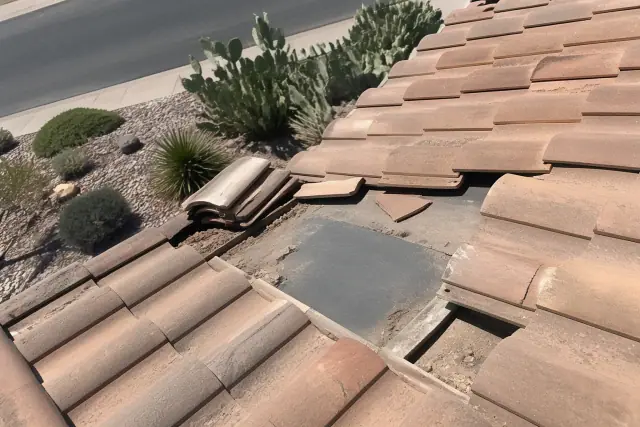
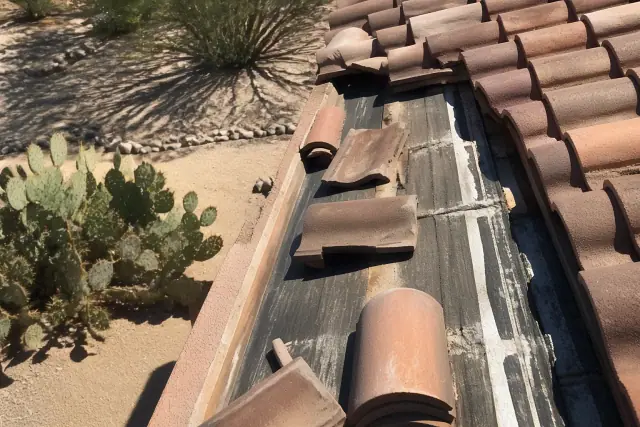
A roofer inspecting a tile roof leak with exposed underlayment in a desert landscape in Tucson, AZ.

We trace water beyond the interior stain, lift the surrounding tile, inspect felt or synthetic underlayment, and replace the compromised section. The investigation also checks pipe boots, valley metal, hip and ridge mortar, and backed-out nail penetrations that can hide the actual entry point.

Request Estimate

Emergency Tile Roof Repair

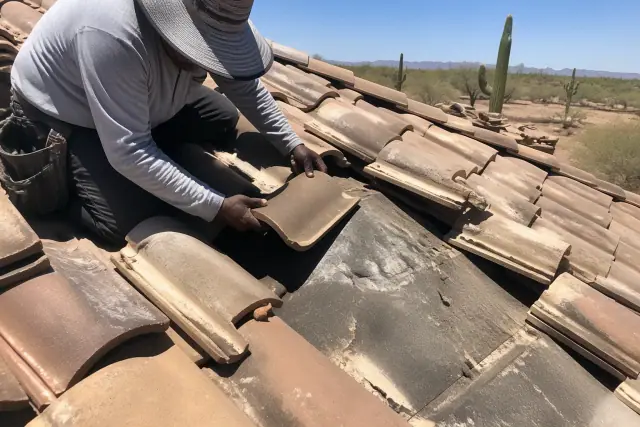
Clay tiles being removed and inspected for roof repair under bright sun in Tucson, AZ.

Active water intrusion, wind-exposed underlayment, and tree-limb punctures require prompt attention. We prioritize active leaks and install a tarp or peel-and-stick membrane the same day whenever conditions allow safe roof access, then schedule the permanent repair after matching tile and confirming the underlayment scope.

Request Estimate

Lift-and-Relay Underlayment Repair

Roofer removing clay tiles to repair synthetic underlayment on a steep roof in Tucson, AZ.

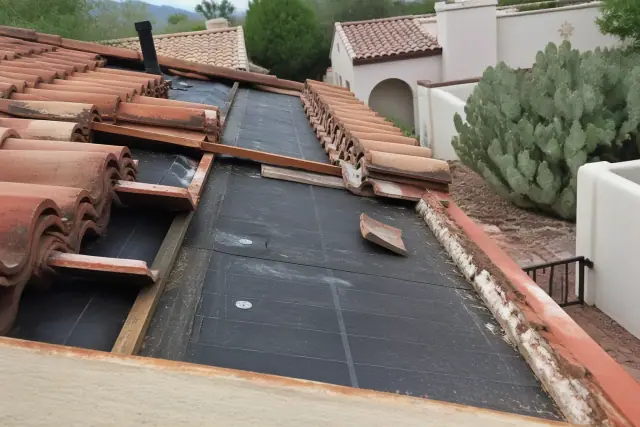
When tile remains sound but the membrane below has failed, lift and relay preserves the existing field. We remove and stack the tile in order, replace underlayment and battens as needed, then reset the original pieces in their prior positions with matched replacements for breakage.

Request Estimate
Repair Approaches

Tile Roof Repair Options

Tile material, damage pattern, underlayment condition, and profile availability determine the right repair method. These options let us tailor the work to an isolated defect, a failing roof plane, or a broader restoration need.

Clay roof tiles being repaired at a residential home with desert landscaping in Tucson, AZ.

Spot Tile Repairs

Spot repair is suited to localized damage where the surrounding tile field and underlayment remain serviceable. It limits removal to the affected area while still checking what lies below the visible break.

  • Hairline-cracked tile from foot traffic or hail
  • Shattered tile from palm fronds or monsoon debris
  • Slipped or missing pieces after high wind
  • Loose tile caused by fastener or foam-adhesive failure
  • Matching pieces for discontinued profiles
Request Estimate
A roofer inspecting clay roof tiles and underlayment on a residential home in Tucson, AZ.

Clay Tile Repairs

Clay tile is fired to standards similar to ASTM C1167 and resists Tucson's UV load, but it is brittle under impact. Thermal movement between 105-degree afternoons and cooler desert nights can stress mortar and fastening over 20 to 30 years.

  • Profile matching through salvage yards and specialty suppliers
  • Replacement of brittle, shattered, or impact-damaged pieces
  • Re-securing fields loosened by wind gusts exceeding 50 mph
  • Code-compliant nail, wire, or other specified fastening
  • Flashing repair at valleys and roof penetrations
Request Estimate
A roofer repairing clay tiles on a roof with visible underlayment and saguaro cacti in the background in Tucson, AZ.

Concrete Tile Repairs

Concrete tile is manufactured under specifications such as ASTM C1492 and offers more impact resistance than clay. Its factory color coat can fade and chalk over 15 to 20 years in Arizona sun, making color evaluation part of the repair plan.

  • Replacement of spalled or cracked concrete pieces
  • Correction of batten, fastener, or foam-adhesive failure
  • Profile and color matching for the existing field
  • Re-coating consideration when faded tile affects the match
  • Underlayment evaluation below affected roof planes
Request Estimate
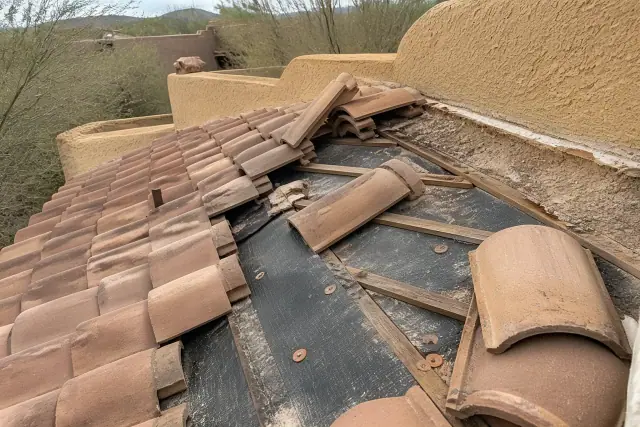
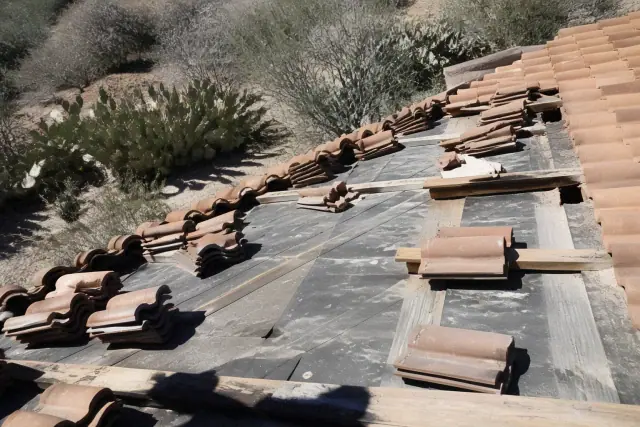
Exposed roof deck with new underlayment, removed terracotta tiles, and cacti in a Tucson, AZ residential backyard.

Lift-and-Relay Underlayment Renewal

Underlayment commonly reaches the end of its 15 to 30 year service life before the tile does, especially on Tucson-area homes built in the 1990s and early 2000s. Lift and relay exposes that membrane while preserving tile that may no longer be manufactured.

  • Careful removal of the existing tile field
  • Numbered stacking to preserve the original layout
  • Replacement of failed underlayment and battens
  • High-heat synthetic or self-adhering modified bitumen membrane
  • Resetting original tile with matched replacements for breakage
Request Estimate
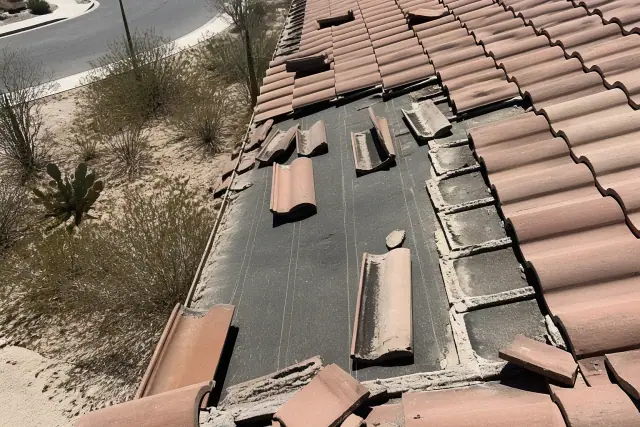
A roofer inspecting displaced clay tiles and the waterproof membrane on a roof in Tucson, AZ.

Full Tile Roof Restoration

Clay and concrete tile can last 40 to 50 years or longer, so restoration often focuses on renewing the supporting assembly rather than discarding the field. We scope restoration with a written inspection report covering each roof plane's tile condition, estimated underlayment age, and flashing condition.

  • Broken, cracked, loose, and missing tile repair
  • Underlayment replacement where the membrane has failed
  • Flashing upgrades at vulnerable transitions and penetrations
  • Protective coating when adjacent flat roof sections require it
  • Written scope explaining the condition and reason for each repair
Request Estimate
Finding Your Right Fit

Choosing the Right Repair Approach

Spot repair and underlayment patching are usually appropriate when less than roughly 25 percent of a tile field is damaged and the surrounding assembly remains sound. Broader failure can make lift and relay or replacement more cost-effective than repeated patches. Tile type, affected planes, discontinued profiles, two-story access, and pitches over a 6:12 slope also influence the recommendation and labor involved.

Licensed, Bonded & Insured

Tucson Quality Roofing operates as a licensed, bonded, and insured Arizona roofing contractor. Repairs follow clay and concrete tile manufacturer specifications along with applicable International Building Code and City of Tucson permit requirements.

Failure-Focused Inspections

We inspect the full roof plane and walk tile with foam pads to avoid creating new breakage. By documenting the damaged pieces and checking underlayment, flashing, fasteners, and mortar, we can recommend the repair the assembly actually needs rather than defaulting to a full tear-off.

Tile Matching & High-Heat Materials

Older adobe-style and Territorial homes often carry profiles that are no longer manufactured. We source compatible pieces through regional salvage yards and inventories, then pair the repair with self-adhering modified bitumen or synthetic underlayment rated for high-heat tile assemblies when membrane work is required.

What Sets Us Apart

Why Choose Us for Tile Roof Repairs?

Our approach connects the visible damage to the roof assembly beneath it. Whether the property is a Foothills home, an older tile roof near the University of Arizona, or a Tucson commercial building, the written scope explains the failed component, the recommended repair, and the reason for the work.

Request an Inspection

Cracked or Spalling Tile

Hairline cracks, shattered clay, spalling concrete, and surface granule loss can expose the assembly below. A single cracked tile can let water track beneath the field, and a repair left through two or three monsoon seasons can grow into damaged underlayment or decking.

Slipped or Missing Tile

Monsoon winds, dust storms, and haboobs can move tile out of alignment without creating an obvious break. Slipped or missing pieces leave felt or synthetic membrane exposed to intense UV and rain, so a ground-level view may not show the full scope.

Failed Underlayment

Tile may look intact while aged felt or synthetic membrane below has split, dried, or lost its seal. Once the underlayment fails, water can reach the decking even though the roof still appears complete from the street.

Flashing and Valley Leaks

Deteriorated valley metal, failed pipe boots, cracked mortar at hip and ridge lines, and backed-out nail penetrations are common hidden entry points. Water often travels along the underlayment before appearing inside, so the ceiling stain may not sit below the actual leak.

Monsoon, Hail & Debris Damage

Hail impact, wind-driven debris, and falling palm fronds can crack or puncture a tile roof in minutes. Active water intrusion, exposed underlayment, or a tree-limb puncture should be addressed before another storm cycle so insulation and drywall do not become saturated.

Loose Fasteners & Deteriorated Mortar

Thermal cycling and repeated wind load can loosen nails, wire ties, foam adhesive, and mortar-set tile over time. Repairing the fastening or flashing condition is more durable than pushing a loose piece back into place or covering a failed joint with caulk.

How It Works

Our Tile Roof Repair Process

The process separates visible tile damage from failures in the weatherproofing assembly below. Careful access, documentation, diagnosis, and material matching let us define the affected area before repair work begins.

01.

Roof Plane Inspection

We inspect the whole roof plane and use foam pads while walking tile to reduce the chance of new breakage. The review considers tile type, pitch, access, penetrations, valleys, and visible staining.

02.

Damage Documentation

Cracked, spalling, slipped, and missing tile is documented by roof plane before the work is quoted. This inventory also identifies discontinued profiles and the number of matching pieces that may need to be sourced.

03.

Leak & Underlayment Diagnosis

Tile around the suspected entry point is lifted so we can inspect felt or synthetic membrane, decking transitions, flashing, fasteners, and mortar. The scope follows the path of failure rather than relying only on where an interior stain appears.

04.

Repair Scope & Written Quote

We outline whether the roof needs individual tile replacement, a localized membrane patch, flashing work, lift and relay, or broader restoration. The written quote reflects material, pitch, access, affected planes, and matching requirements.

05.

Assembly Repair

Compromised underlayment, battens, valley metal, pipe boots, penetrations, or mortar are repaired according to the confirmed scope. High-heat membrane is used where underlayment replacement is required beneath the tile field.

06.

Tile Reset & Matching

Sound original tile is reset in its prior position, and broken pieces are replaced with structurally and visually compatible stock. For lift-and-relay work, numbered stacks help return the field to its original layout.

Plan Your Repair

Schedule a Tile Roof
Repair
Consultation

Request an on-site inspection for broken tile, a suspected leak, underlayment concerns, or a broader restoration. We will document the affected roof plane and prepare a written quote explaining the recommended scope.

Tile Roof Help

Tile Roof Repair FAQs

These answers cover Tucson tile roof repair costs, material life, underlayment, matching, emergency work, and the factors that separate a spot repair from a larger project.

Call Our Roofers

Most Tucson tile roof patches run between $900 and $2,500, with a typical job around $1,700. Small isolated repairs may be as little as $300, while extensive work across multiple planes or underlayment sections can reach $7,000 or more. A rough planning range is $8 to $25 per square foot, depending on tile type, pitch, and access.

Smaller jobs replacing a handful of cracked tiles commonly fall between $300 and $1,500. The final price depends on the tile profile, whether matching salvage stock is needed, roof pitch, brittleness, and safe access. Lift-and-relay work costs more because an entire field must be removed and reset.

Clay and concrete roof tile can last 40 to 50 years or longer. The underlayment below it commonly needs replacement every 15 to 30 years, depending on the material and installation quality. Inspection, debris removal, and prompt tile replacement help protect that shorter-lived membrane.

Full tile roof replacement in the Tucson region generally ranges from $15,000 to $35,000, depending on square footage, tile material, and roof complexity. Tile installation is roughly $600 to $1,200 per square, plus about $50 to $70 per square in labor; custom clay and complex multi-plane roofs can cost more. An on-site inspection is needed for a detailed written quote.

The tile itself rarely determines the replacement date because it can remain serviceable for decades. Underlayment failure or accumulated damage across a roof plane is more likely to drive major work. We evaluate both conditions instead of recommending replacement based on tile age alone.

The 25 percent rule is a common repair-assessment guideline and appears in some jurisdictions' building codes. When damage or required work affects roughly 25 percent or more of a roof surface, replacing that section may be more economical and can sometimes be code-required. We apply the same logic when repeated patches would leave a broadly failing tile field or underlayment in place.

Yes. Many Tucson homes built from the 1970s through the 1990s have clay or concrete profiles that are no longer manufactured, so we source replacement pieces through regional salvage yards and tile inventories. If an exact match is unavailable, we help identify the closest structurally and visually compatible option for the affected plane.

Tucson Quality Roofing is a licensed, bonded, and insured roofing contractor in Arizona. Repair work follows manufacturer installation specifications along with applicable International Building Code and City of Tucson permit requirements. Proper fastening and underlayment installation are especially important on tile roofs because errors can lead to early leaks.

Look for cracked or spalling tile, granule loss, pieces that have slipped out of alignment, missing tile, and ceiling stains tied to a roof plane. Monsoon wind and haboobs can loosen tile without a visible break, so a ground-level look may miss damage. A roof-plane inspection can determine whether the issue stops at the tile or continues into the underlayment.

The entry point is often not directly above the interior stain because water can travel along the underlayment before dropping through the decking. We lift tile around the suspected area and inspect the membrane, pipe boots, valley metal, hip and ridge mortar, and nail penetrations. The compromised component is repaired before the tile is reset.

Lift and relay means carefully removing the existing tile field, replacing failed underlayment and battens, and resetting the original tile. The pieces are numbered and stacked so they return to their original positions. This approach preserves serviceable tile while correcting the hidden membrane failure.

Active water intrusion during a monsoon, a wind-blown tile that exposes the underlayment, or a tree-limb puncture calls for prompt attention. We prioritize active leaks and can install temporary weatherproofing the same day when conditions permit safe roof access. Permanent work follows after the matching tile and underlayment scope are confirmed.

We use self-adhering modified bitumen or synthetic underlayment rated for high-heat tile assemblies when membrane replacement is required. Standard 30-pound felt degrades faster beneath tile surfaces that can drive a summer roof deck above 150 degrees. The appropriate material depends on the assembly and repair scope.