Typical Tucson Roof Cost
A full tear-off and replacement usually lands between $7,500 and $20,000 across Tucson and Pima County, but roof-specific conditions determine the final number.
Tucson Quality Roofing explains that a full roof replacement in Tucson typically costs $7,500 to $20,000, but material, roof pitch, square footage, decking condition, and tear-off complexity can move the total substantially. A physical inspection is the most reliable way to account for tile weight, hidden water intrusion, and monsoon-related damage.
A full tear-off and replacement usually lands between $7,500 and $20,000 across Tucson and Pima County, but roof-specific conditions determine the final number.
Asphalt shingles set the lower baseline, while standing seam metal, clay or concrete tile, steep pitches, multiple stories, and added tear-off layers raise material or labor costs.
An on-roof inspection can reveal damaged decking, water intrusion, tile-weight concerns, and old layers that a size-only estimate cannot capture.
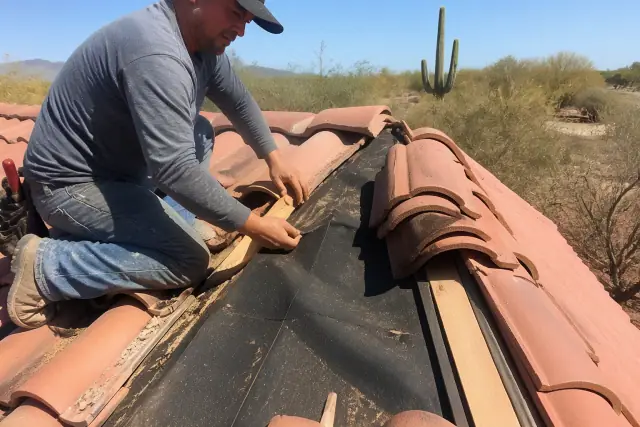
Show the visible differences among asphalt shingles, clay or concrete tile, standing seam metal, and a low-slope surface. Material choice is the clearest visual signal of where a replacement may fall within the price range.
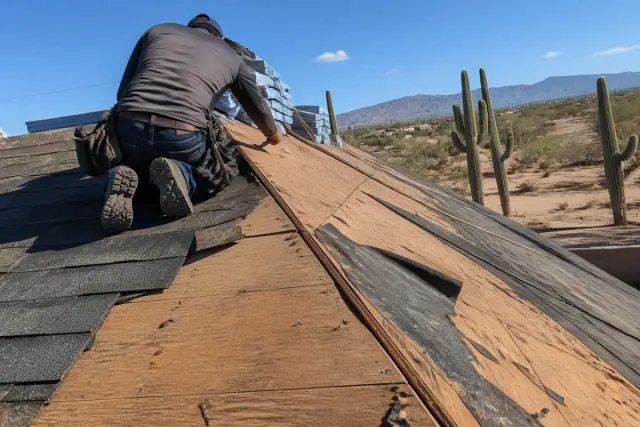
Show a steep or multi-story roof beside a simpler one-story roof, including stacked tear-off layers. The comparison explains why equal square footage can require very different labor and access plans.
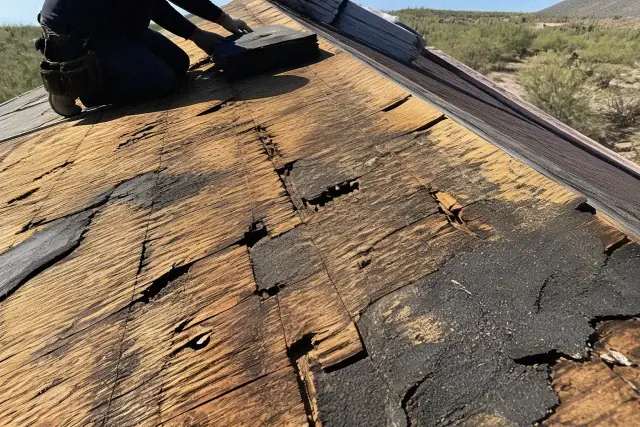
Show lifted roofing material revealing stained or deteriorated decking below. Hidden water intrusion can expand the scope after tear-off, so this condition matters before final pricing.
Asphalt shingles cost about $4.25 per sq ft installed, placing a 2,000 sq ft roof around $7,000 to $14,000 before unusual access or decking work.
Standing seam metal costs roughly $8.75 per sq ft, and a 20-square roof typically totals $10,000 to $16,000; some projects begin around $14,000 and rise with scope.
Tile replacements commonly run $16,000 to $36,000, or about $8 to $18 per sq ft, because material weight may add truss, decking, or reinforcement requirements.
Most residential tear-off and replacement projects take one to three days. Fall through early spring avoids much of the June-through-September monsoon window, while tile and multi-layer tear-offs may take longer.
| Roof Material or System | Source Cost Benchmark | Key Estimate Factor |
|---|---|---|
| Asphalt shingles | About $4.25 per sq ft; $7,000 to $14,000 for a 2,000 sq ft roof | Pitch, stories, tear-off layers, and decking condition |
| Standing seam metal | Roughly $8.75 per sq ft; $10,000 to $16,000 for a 20-square roof | Materials run $400 to $800 per square, with labor adding $35 to $50 per square |
| Clay or concrete tile | $16,000 to $36,000; a 20-square tile roof runs $15,000 to $28,000 | Tile weight can require truss and decking inspection |
| Flat or low-slope roof | Inspection-based pricing | Decking moisture and the choice among modified bitumen, TPO, coating, or foam |
The broad Tucson benchmark is $7,500 to $20,000, but simpler roofs can fall around $6,322 to $7,134 and a 1,900 sq ft home may land closer to $9,814 to $13,277. Across southern Arizona, standard replacement ranges from about $4 to $11 per sq ft, while recent regional scope comparisons span $8,900 to $29,500. Those figures are planning ranges, not substitutes for inspecting the roof surface, underlayment, decking, pitch, access, and removal needs.
Material choice drives the largest swing, followed by roof pitch, number of stories, access, existing layers, damaged decking, and permit fees through Pima County Development Services. HOA material restrictions can narrow the options, while monsoon demand can affect rush scheduling. When damage exceeds 25% of a roof surface, code or insurance guidelines often move the decision from a targeted repair toward replacing the full roof section.
Standard architectural shingles typically last 15 to 20 years in Arizona's climate, while heat-rated shingles may reach 20 to 25 years and tile or metal can reach 40-plus years with proper underlayment maintenance. A 20-year-old shingle roof, or one showing granule loss, curling, cracked tile, or recurring leaks, merits a full inspection; checking wear around the 15-year mark can make replacement easier to plan. Homeowners insurance may cover replacement after a covered wind, hail, or storm event, but it generally does not cover gradual wear or neglected maintenance.
Share the roof type, approximate size, visible damage, and any leak history. A physical inspection can confirm the surface condition, underlayment, decking, access, and tear-off scope before the replacement price is finalized.